
- The Financial Happiness Index reading fell sharply from 3.97 on October 21 to 3.76 on October 24
- The Index score recovered following the Chancellor’s Budget on October 28
- Following the Bank of England’s interest rate announcement on November 5, financial happiness dropped again, driven by a decrease in the emotional resilience score
Findings from Dynamic Planner’s Financial Happiness Index™ reveal that UK financial happiness has dropped following recent announcements from the government and the Bank of England.
The analysis, based on responses from around 4,000 people every month, found that happiness decreased on the launch day of the UK government’s “Be Ready” campaign (October 22), which asked households to keep enough supplies to manage for three days if essential services fail.
The Index score also fell in the days following the announcement, which coincided with UK Defence Secretary Wes Streeting’s message that Britain had a little over 1,000 days to be ready to fight alongside its allies, with the Index shifting from 3.97 on October 21 to 3.76 on October 24. Emotional resilience and financial confidence dropped over this period more so than financial resilience.
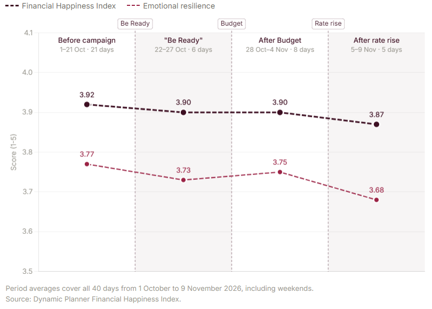
Figure 1 shows average financial happiness and emotional resilience during key periods between October 1 and November 9.
The period around the Autumn Budget reveals a different pattern. Following the Chancellor of the Exchequer John Healey’s Budget on October 28, the Index score rose from 3.94 that day to 4.00 on November 2.
However, this recovery didn’t last. After the Bank of England’s decision to raise the interest rates on November 5 from 3.75% to 4%, and with news about house prices falling, hiring dropping and a warning issued about tighter electrical supply margins, financial happiness dropped to as low as 3.78 on November 9. Emotional resilience took a particularly big hit, dropping to 3.47 on the same day.
Dr Louis Williams, Head of Psychology & Behavioural Insights at Dynamic Planner, said: “The Financial Happiness Index reading may have dropped by only 0.05 across the four distinct periods measured from October to November, but that doesn’t reflect the ups and downs experienced by those surveyed during that time, with changes in the scores coinciding with a varied news agenda.
“It’s no surprise that emotional resilience has taken a particularly big hit considering some of these developments, including the ‘Be Ready’ campaign and war preparedness messaging, unsettle how people are feeling rather than directly impacting their finances in the short term.
“For advisers, these results may be a useful prompt for conversations about what is causing their clients concern, how the wider economic picture relates to their individual circumstances, and whether anything has changed in the assumptions underpinning their current financial plans.”