
Dynamic Planner, the UK’s leading digital advice platform, has analysed the data from 9000 Financial Wellbeing and Attitude to Risk Questionnaires*, to reveal insightful and actionable findings ahead of International Women’s Day.
With research consistently showing that women, on average, have less exposure to financial education and investing opportunities, a self-reinforcing cycle can be created where limited experience leads to lower financial confidence and more conservative investment choices. Over time this can translate into lower returns and less wealth accumulation than men.
With International Women’s Day putting an annual focus on women, the analysis undertaken by Dr Louis Williams, Dynamic Planner’s Head of Psychology and Behavioural Insights aims to shine a light on women’s financial wellbeing: their risk tolerance, resilience and capabilities, where they are flourishing, and where additional support or coaching from their adviser may be beneficial, whether it’s the 8th March or year round.
Understanding risk profile and women
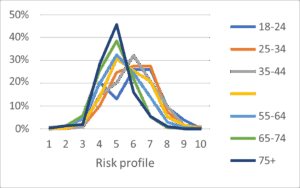
As often reported, women tend to be more risk averse than men. The charts below show that 21% of females are a Risk profile (RP) 4** compared to only 12% of males, whilst 21% of males are a RP7 compared to 13% of females (see figure 1a). Age has an effect on risk profile with older women tending to be more risk averse than younger women, for example, 35% of 25–34-year-olds are a RP7 or RP8 compared to just 7% of those over 75 (see figure 1b).
Figure 1: a) distribution of risk profiles (1-10) for males and females.
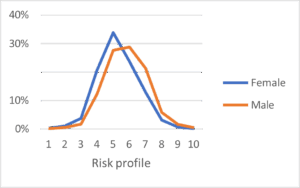
Figure 1: b) distribution of risk profiles (1-10) for females only across age groups.
Resilience gender gap
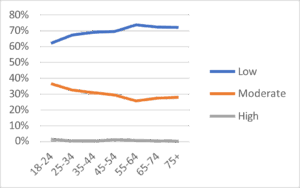
Overall, a very small percentage of people are highly vulnerable regarding their resilience, but there is a difference between gender, with a higher percentage of men (76%) having a low level of vulnerability than women (67%) (see figure 2a). As age increases so does resilience, with older women having a lower level of vulnerability (see figure 2b).
a. b.
Figure 2: a) Propotion of males and females with low, moderate and high levels of vulnerability according to their resilience.
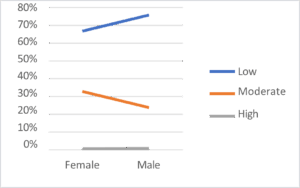
Figure 2: b) Propotion of females with low, moderate and high levels of vulnerability according to their resilience across age groups.
Further analysis reveals that men can better handle changes to their finances if they were to lose their main source of income or experience an increase in their mortgage or rent. However, the differences across genders are largely influenced by emotional factors. Emotional resilience is stronger for men, for example:
- 64% of men versus 55% of women do not find it hard to make progress with their finances.
- Emotions during uncertain periods also differs due to gender, with more women feeling stressed when taking risk (23%) compared to men (12%) and uncertainty stopping more women from making financial decisions (23%) compared to men (14%).
- Reassuringly, healthy emotion regulation strategies are being used slightly more by women compared to men, 76% of women stay calm by thinking positively during stressful periods compared to 72% of men.
Capability differences between men and women
Dynamic Planner also found differences between the vulnerability characteristics that inform and make up a client’s capability:
- Men have a higher level of financial knowledge and confidence, for example 83% of men compared to 76% of women are confident in their abilities to manage their finances (financial self-efficacy).
- 54% of men compared to 40% of women agree to some extent that they are knowledgeable about financial matters.
- In contrast, a higher percentage of females have a support network around them if needed (81% compared to 76% of males).
- Slightly more men (53%) than women (50%) strongly agree that they are confident using basic maths, whilst females report higher abilities in their literacy and English language skills.
- 59% of females compared to 53% of males strongly agree that they are able to communicate effectively.
Dr Louis Williams, Head of Psychology and Behavioural Insights, Dynamic Planner said: As we reflect on International Women’s Day 2026, the conversation around gender and finance must move beyond simple comparisons and toward deeper understanding.
“While we find that women are more risk averse, have lower resilience and financial confidence than men, at the same time, our research also highlights important strengths. Women use healthier coping strategies to manage their emotions, have better communication skills, and strong support networks.
“These findings support opening up the ability to have conversations with women and provide an opportunity for advisers to offer the guidance and support where necessary in order to help women elevate their financial wellbeing.”